
Health & Sleep — Editorial
The 3AM Problem: Why So Many People on Daily Reflux Medication Still Wake Up Burning — And Why It Has More to Do With Gravity Than Your Dose
You take the pill. You stopped eating late. So why does the acid still win at night? The answer is something most people are never told — and once you see it, you can't unsee it.

You take your pill every morning, exactly the way you're supposed to.
You stopped eating after 7. You gave up the late coffee. Maybe you've cut the wine, the tomatoes, the chocolate too.
And still — somewhere around 2 or 3am — you wake up with that familiar burn climbing your throat.
If that's you, read this to the end. Because you're not doing anything wrong. And the reason your nights are still broken has almost nothing to do with your medication.
The mystery
Here's the strange part. During the day, the pill mostly does its job — the burn is manageable, you get through. But the moment you lie down and fall asleep, something changes, and nothing you add seems to touch it. By now you've probably started to wonder if this is just how it's going to be from here on. It isn't — but to see why, you have to understand one thing your prescription was never built to do.
What you've already tried
You've been working at this for a while. So let's be honest about what you've already thrown at it:
- You raised the dose. The days got better. The nights didn't.
- You added an antacid at bedtime, or a second medication. It took the edge off — until it didn't.
- You stopped eating hours before bed. You still woke up burning.
- You stacked pillows under your head. By 2am you'd slid flat again — and the acid came right back.
Notice what every one of those has in common. They all target the same thing: how much acid your stomach makes.
Not one of them changes where that acid goes once you're lying down.
That's the part nobody explained to you.
Chemistry vs. physics
Your pill works on chemistry. It signals your stomach to produce less acid. That's its entire job, and it does it.
But your reflux at night isn't only a chemistry problem. It's a physics problem.
When you lie flat, your stomach and your throat sit on the same level. Whatever acid is still in your stomach — and there is always some — has a clear, uphill-free path straight into your esophagus. Gravity, the thing that quietly keeps acid down all day while you're upright, does nothing for you the second your body goes horizontal.
It's not your dose. It's gravity.
The pill reduces the acid. It cannot move it. No pill can. That was never what it was built to do.
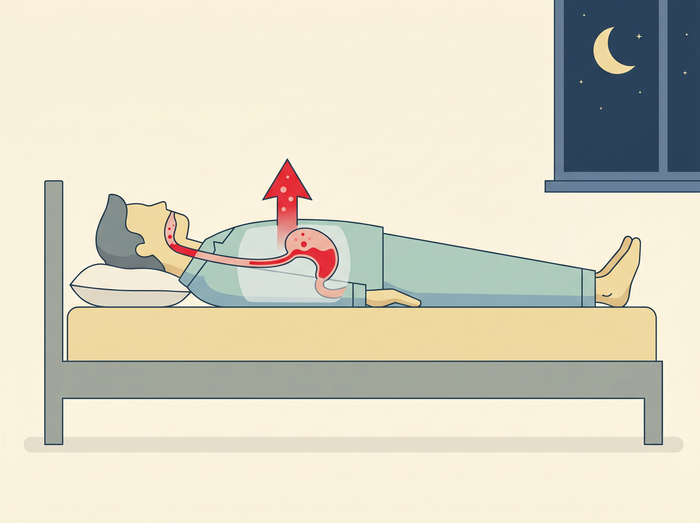
A — Lying flat
Lying flat, nothing stops the acid from rising.
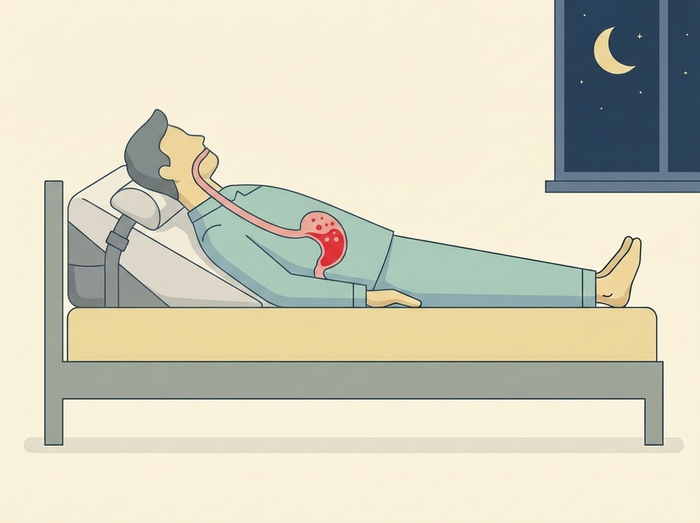
B — Elevated
Elevated, gravity keeps the acid where it belongs.
What the science says
This isn't a theory someone invented to sell you a pillow.
The research says the same thing: raising the upper body during sleep lowers how much acid reaches the esophagus overnight and reduces nighttime symptoms — and it does it without another drug.2,3
Elevation isn't an alternative to your medication. It's the half of the equation your medication was never able to cover.
Why "just prop yourself up" hasn't worked
So if elevation is this important, why hasn't it already fixed your nights?
Because the way most people try to elevate is broken:
- Stacked pillows lift your head, not your torso — and they collapse and slide out from under you by the middle of the night, dropping you flat at exactly the moment the acid rises.
- A head-only wedge bends you at the neck instead of raising your whole upper body. It's uncomfortable, and it doesn't hold the angle till morning.
What actually works is a stable, supported incline that raises your entire upper body — torso, not just head — and keeps it there all night.
That's a specific shape. It's not a softer pillow. It's an angle.
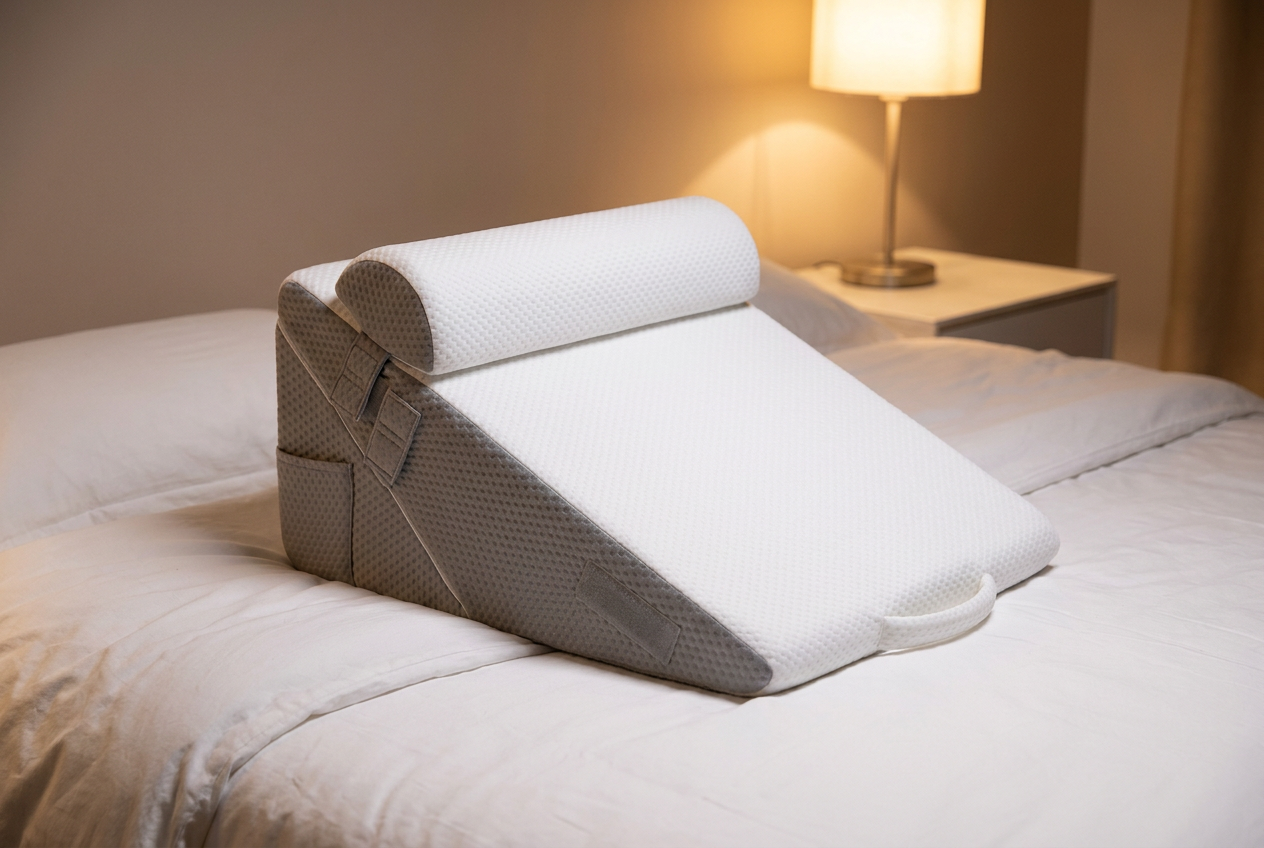
That's the one thing FAVIX was built to do.
FAVIX is a sleep-elevation wedge engineered to hold your upper body at the incline used for nighttime reflux — and to keep it there, comfortably, until morning. Not a foam triangle that flattens in a month. Not a head-only prop that wrecks your neck. A stable angle for your whole torso — the part the pill could never reach.
60-night trial · free shipping
Keep your medication — this isn't an either/or
Let's be clear about one thing, because it matters.
This is not about getting off your medication. Don't change anything your doctor prescribed.
Your pill does real work on the acid your stomach produces — keep taking it exactly as directed. FAVIX handles a completely different part of the problem: the position your body is in while you sleep.
One works on chemistry. The other works on physics. They were never competitors. They're the two halves that were always meant to work together — and until now, you've only been using one of them.
What people are saying
Still burning at 3am even at 40mg. My daughter kept sending me this link and I kept ignoring her. Finally tried it. Two weeks in and the 3am wake-ups are gone. She was right
4 years on omeprazole. Stopped eating after 7, cut out coffee, did everything right. Still woke up burning at 2am. Three weeks on this and the nighttime burning just stopped. I don't fully understand the mechanics but I stopped questioning it
If you've spent years doing everything right and still wake up burning, it was never a failure of effort. It was a missing half of the equation.
You can keep treating the chemistry. Or you can finally address the physics too — starting tonight.
Free shipping · Full refund if your nights don't change · Keep taking your medication as prescribed
References
- Katz PO, Dunbar KB, Schnoll-Sussman FH, et al. ACG Clinical Guideline for the Diagnosis and Management of Gastroesophageal Reflux Disease. Am J Gastroenterol. 2022;117(1):27–56.
- Ness-Jensen E, Hveem K, El-Serag H, et al. Lifestyle Intervention in Gastroesophageal Reflux Disease. Clin Gastroenterol Hepatol. 2016;14(2):175–182.
- Albarqouni L, Moynihan R, Clark J, et al. Head of bed elevation to relieve gastroesophageal reflux symptoms: a systematic review. BMC Fam Pract. 2021;22:24.
FAVIX is not a medical device and is not intended to diagnose, treat, cure, or prevent any disease or medical condition, including gastroesophageal reflux disease. The information on this page is educational and is not medical advice. Do not start, stop, or change any prescribed medication without consulting your doctor. If you have persistent or severe nighttime reflux, speak with a qualified healthcare provider.